
What Is Resistance Welding
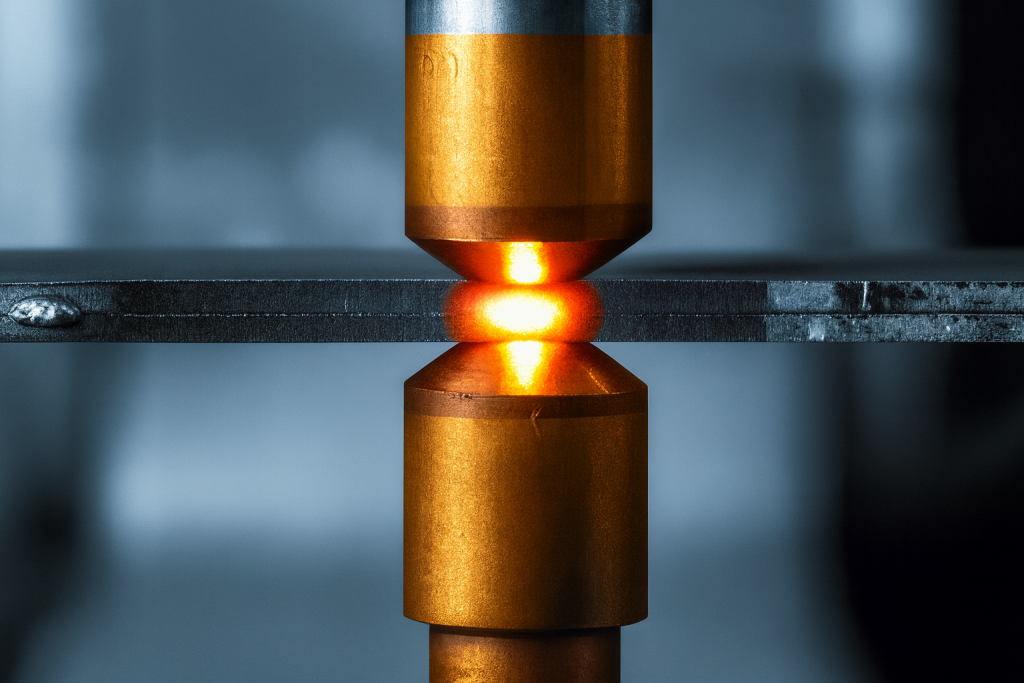
Resistance welding joins two similar or dissimilar metals together. It uses high current, pressure, and heat to create the bond.
The Main Advantage
You don’t need extra material to complete the weld. This makes resistance welding reliable, repeatable, and cost-effective.
Types of Resistance Welding
Several forms exist, including spot, seam, projection, flash, and upset welding. Each type differs by the electrodes used. The electrodes apply pressure and conduct current to the weld point.
Manufacturers make electrodes from copper-based alloys. These materials offer superior conductive properties. Water flows through cavities inside the electrode to cool the tooling during operation.
 |
 |
| Resistance Spot Welding | Resistance Projection Welding |
|
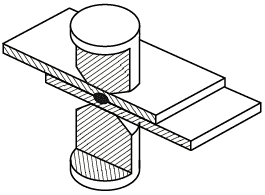
Spot welding creates welds using heat from electrical current resistance. The process also applies force to push workpieces together over a defined time. The electrode face geometries focus welding current at the desired location. They also apply force to the workpieces. The materials heat up, combine, and form a weld nugget. |
Projection welding uses heat from electrical current resistance. It applies force over a defined time period. How It Works Common Uses
The wire intersections localize heat generation. The wires set down into one another and form a weld nugget. |
 |
 |
| Resistance Seam Welding | Resistance Upset Welding |
|
Seam welding is a subset of spot welding. It uses wheel-shaped electrodes to deliver force and current. |
Upset welding uses heat from electrical current resistance. It applies force to push workpieces together. Key Difference from Flash Welding |
How Resistance Welding Works
1. Pressure Application
Electrodes or welding tips hold the parts together under mechanical pressure.
2. Current Passage
A high electrical current passes through the joint area. The system controls the timing precisely. Current encounters resistance at contact points and within the material. This generates heat.
3. Heat Generation
The heat level depends on three factors:
- The square of the current
- The resistance of the materials
- The time the current flows
Joule’s Law of Heating: Q = I² · R · t
Where:
- Q = heat generated
- I = current
- R = resistance
- t = time
4. Welding
The materials heat to their melting or near-melting point. The applied pressure fuses the materials together at the interface.
5. Cooling
The current turns off. You maintain pressure while the weld cools. This forms a solid bond.
Types of Resistance Welding Machines
Different machine configurations suit different manufacturing needs. Choose your machine based on part size, production volume, and application requirements.
Rocker Arm Welders
Rocker arm machines use a pivoting arm to bring the upper electrode down. They offer excellent accessibility for irregular-shaped parts. These welders work well for low to medium production volumes.
Benchtop Welders
Benchtop units mount directly to a work surface. They provide a compact footprint for smaller parts. These machines suit prototype work and light production runs.
Press-Type Welders
Press welders use a direct vertical stroke for electrode movement. They deliver consistent, parallel pressure across the weld area. This design handles high production volumes and heavy-duty applications.
Capacitor Discharge (CD) Welders
CD welders store electrical energy in capacitors. They release this energy in an extremely short pulse. This produces minimal heat-affected zones and works well for heat-sensitive materials. You can weld thin to thick materials without warping or distortion.
Common Applications
Engineers design resistance welding machines for automotive, aerospace, and industrial applications. Automation gives manufacturers highly controlled and repeatable results. This allows companies to staff production lines readily.
Advantages of Resistance Welding
High Speed
Resistance welding works very fast. This makes it suitable for mass production.
Clean Process
A correctly calibrated weld produces little to no sparks, smoke, or fumes. This beats arc welding significantly.
Consistency
The correct welding control provides uniform and repeatable welds. You must control parameters appropriately.
No Filler Material
Resistance welding doesn’t require filler metal. This reduces costs and simplifies the process.
More Questions? We’re happy to help, give us a call at (937)-253-3300.